
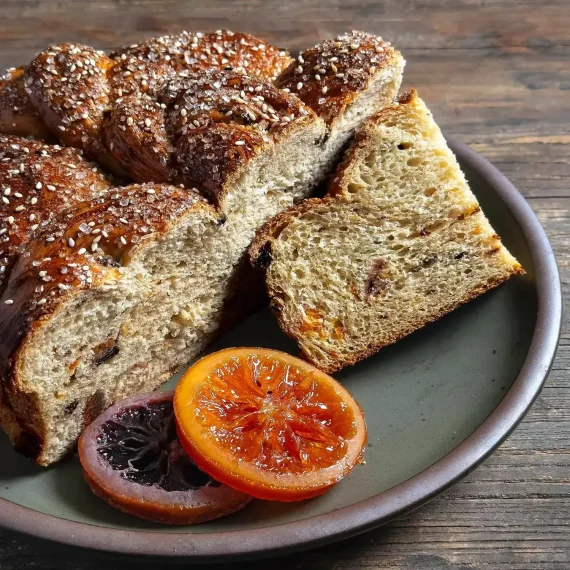
I Have Never Been Happier With Any Bread I’ve Ever Baked!
Soft and buttery, with bits of candied oranges, plumped currants, fennel seeds, and sesame seeds, this bread kind of has it all. But first, an explanation is required. I tend to go down rabbit holes when I run into a recipe or food tradition which intrigues me, but of which I’m unfamiliar. This one began when I was perusing Easter bread traditions. Those types of traditions fascinate me because I’m a bread person. I enjoy baking it more than most anything else. So, when I saw an article about Paska, an enriched bread, traditionally eaten at Easter in Eastern European countries, I was off and running.
Digging around I saw articles that said it was sometimes eaten with sweetened cheese or cheese spreads. I also saw some variations that were studded with candied citrus rinds or raisins. This got me to thinking about how I would choose to flavor and eat a bread of this kind. I wasn’t interested in the sweet cheese spread. I wanted to slice it up, toast it, and spread it with butter.
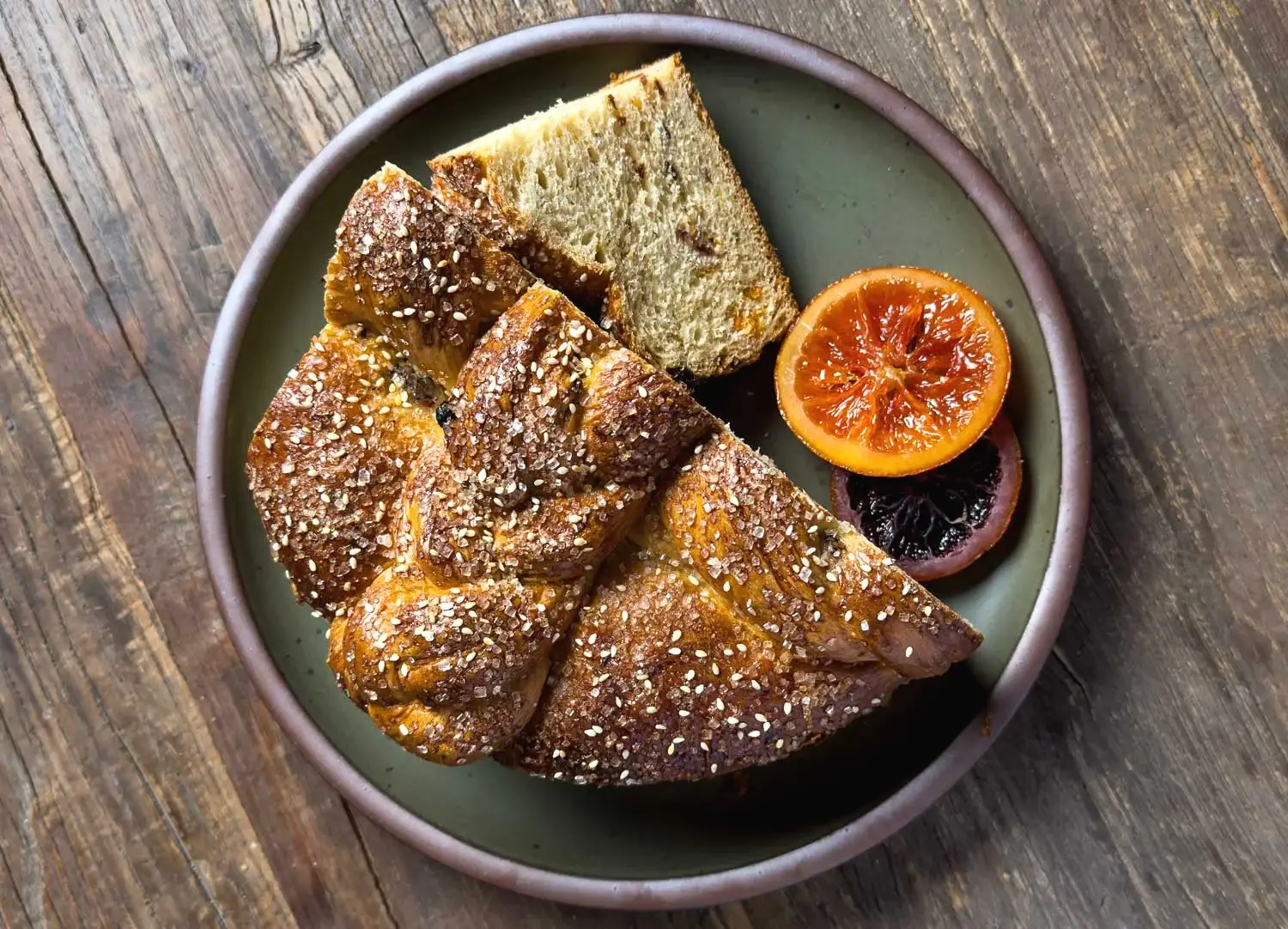
My son has been on a kick of candying slices of oranges – different types such as navel, cara cara, and blood oranges. He’s not been candying only the peels. He’s been candying entire slices and his technique couldn’t be easier. I’ve included the recipe below. These are droolingly delicious. Still juicy but softly candied, we’ve got a stash of them in the freezer, so I knew I wanted to add pieces of these candied oranges to the bread. By the way, besides using them in baking, they’re fantastic on a cheese board, or dunked in a little melted dark chocolate. I love them chopped and stirred into a bowl of plain yogurt. My son’s been adding them to vanilla ice cream. We’re just getting started figuring out all the ways we’ll be using them. If you don’t want to make them, you could purchase some candied orange rind. While it would still be good, it won’t be as good as it could be.
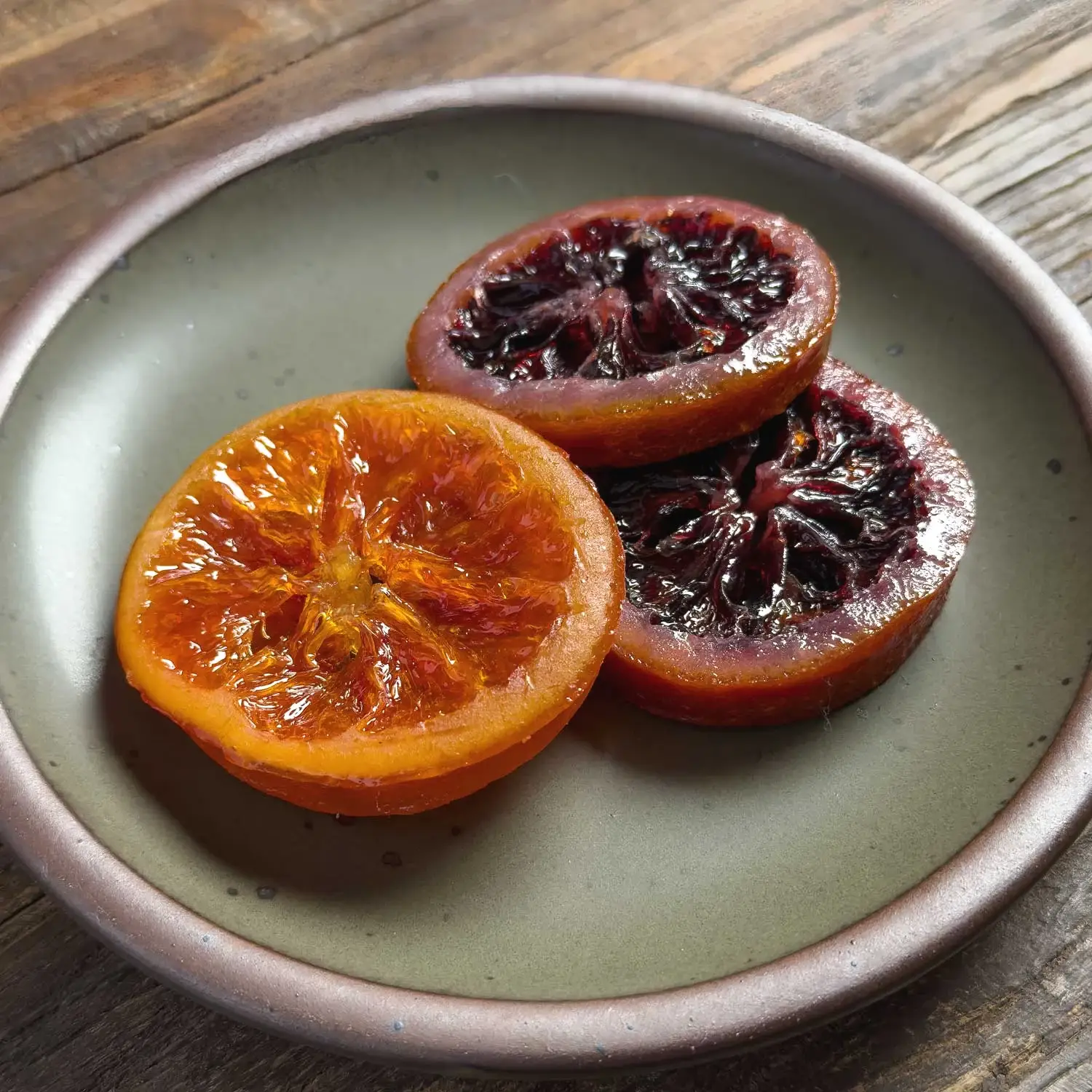
It seemed to me that a deeper flavoring would be a nice balance, so I steeped some dried currants * in a little orange juice and tossed them into the dough. But I also wanted some type of warm flavor and finally decided on toasted fennel seeds. Their earthy quality seemed like a good match with the other things I had going on here.
Having figured out what additions I was going to use, I had to decide on my base recipe for the dough and ended up using King Arthur’s recipe because I know I can trust their recipes. It’s a straightforward yeast dough, enriched with an egg, butter, and milk. But there’s not an overabundance of enrichment, which was what I wanted. I didn’t want to end up with a brioche type of bread. This bread needed to be able to stand up to containing my additions, be easily sliced, and not so soft that it falls apart.
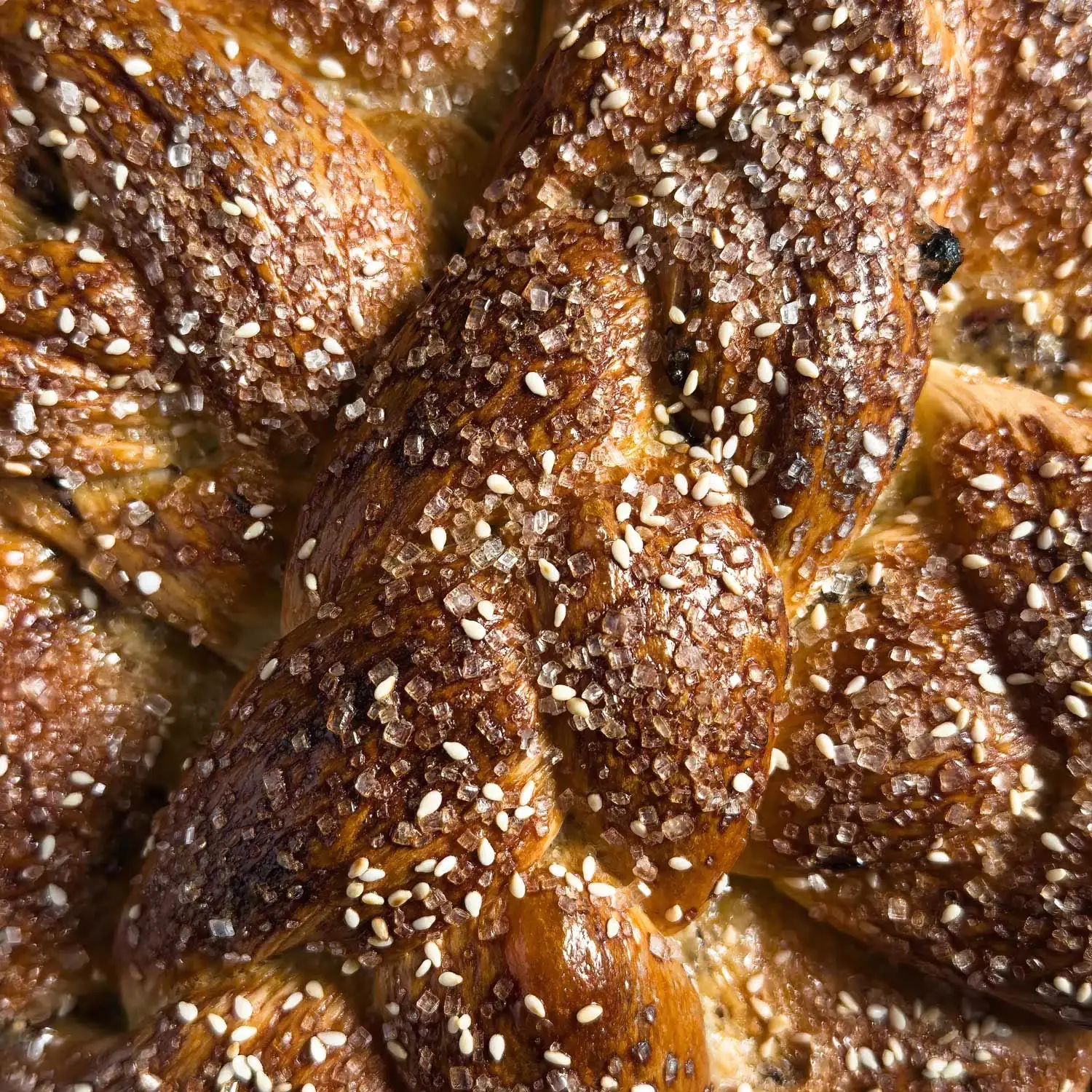
The most common shape of the loaf had a braid that ran around the perimeter of the loaf, but I liked one of King Arthur’s variations that had a braid in a criss-cross pattern on top of the loaf. I decided that dividing and rolling out a portion of the dough into the 3 long strands that are necessary for a braid wouldn’t work very well if the dough had pieces of candied orange in it, so before adding the citrus I went ahead and took out a third of the dough, which only contained the currants and fennel seeds and let it rise separately from the rest of the dough to which I added the candied oranges.
After the first rise, I shaped the dough and topped it with the braid. The loaf is baked in a 9 inch cake pan and I was hoping for a nice tall rise. It did not let me down. It rose up beautifully. Right before it went into the oven I brushed it with an egg wash, sprinkled on sparkling sugar ,* and sesame seeds. Watching it bake reinforced my feelings about baking breads. It continued to rise in the oven and developed a gorgeous crust. I know it sounds trite, but it really does feel magical to watch bread grow from a blob of dough into something so beautiful. The thrill is always there for me.
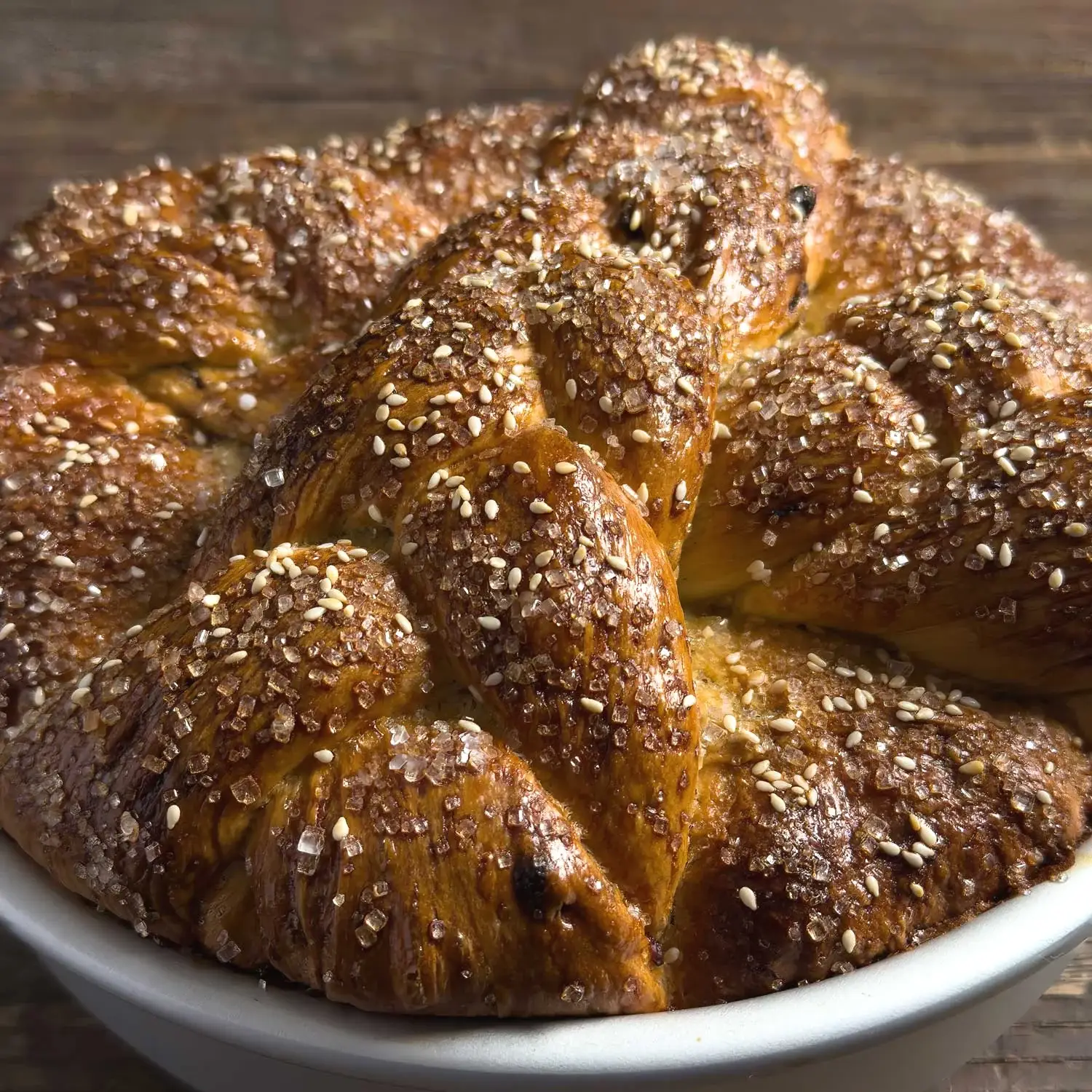
But of course, what’s most important is how does it taste?? Not having the patience to wait for it to completely cool, we tried a slightly warm slice, all on its own and what an absolute delight it is. I didn’t overwhelm it with additions, so I could get a good sense of the bread itself and it’s even lovelier than I had hoped. It is very tender, but crusty, and has a rich butter flavor. But those additions are what took it to another level. I loved the candied bits of orange, the currants, and the fennel seeds. They were a perfect match. But if fennel seeds aren’t your thing, simply omit them, although I think they nicely balanced the flavors and added a lot of interest. After toasting a slice and slathering on some butter I knew I’d chosen well. I wouldn’t alter it in any way.
Although this is traditionally made at Easter, I will be making it throughout the year. It’s too good to save for only one day of the year.
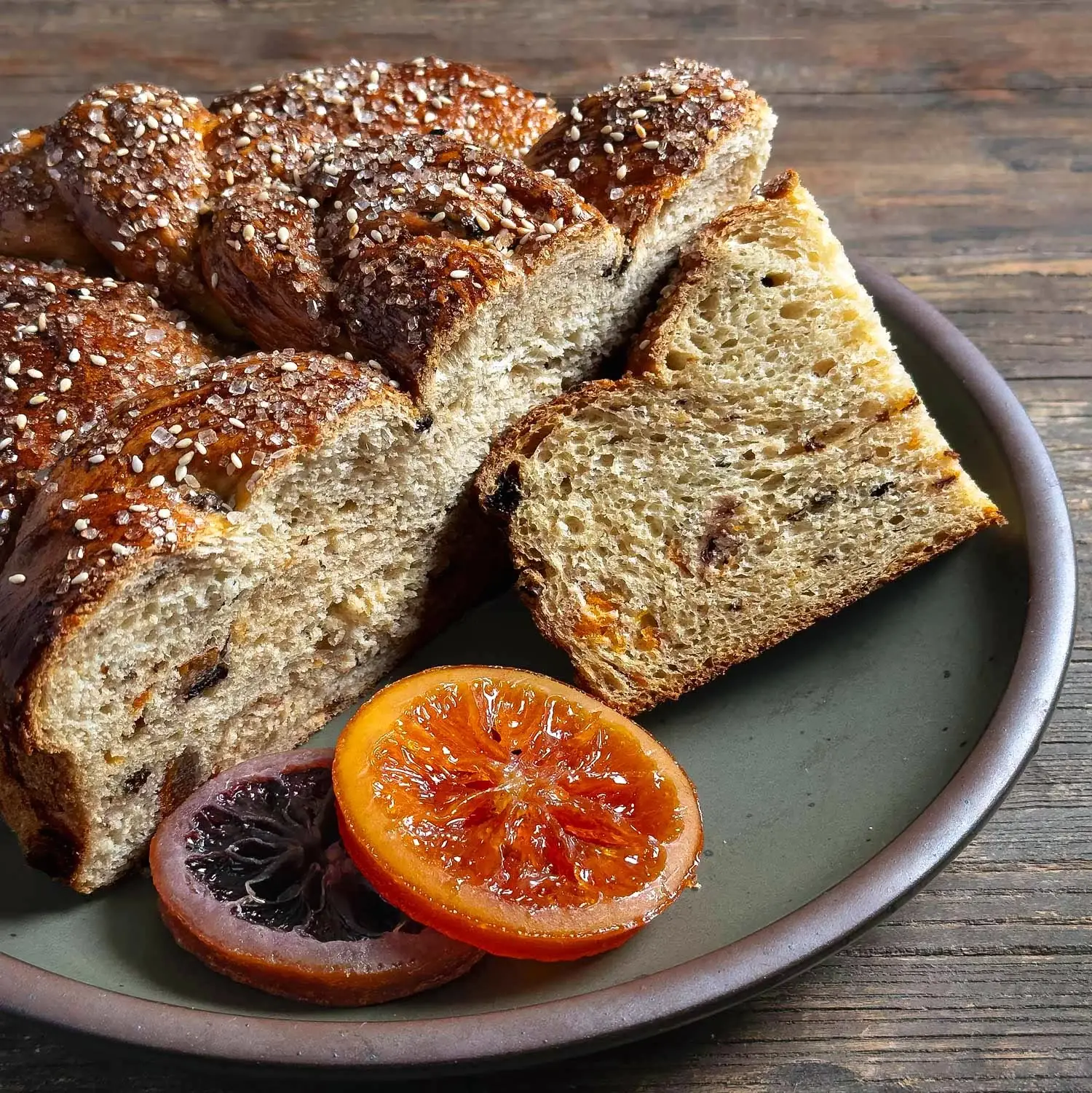
Buttery Orange Bread
An enriched buttery bread filled with candied orange pieces, dried currants, and fennel seeds. I adapted the recipe for the base dough from King Arthur's recipe for Paska by Robyn Sargent.
20
servingsKeep the screen of your device on
Ingredients
- Buttery Orange Bread
3 tablespoons (27g) dried currants *
2 tablespoons orange juice
1 cup (227g) lukewarm water
1/2 cup (113g) whole milk
1 large egg
4 tablespoons (57g) salted butter, room temperature
5 cups (600g) King Arthur Unbleached All-Purpose Flour
1 tablespoon instant yeast
2 tablespoons (25g) granulated sugar
2 1/2 teaspoons (15g) table salt
1 1/2 teaspoons fennel seeds, toasted in a dry skillet over medium heat for one minute
4 - 1/3 inch thick slices of candied oranges (see recipe below), cut into 1/2 inch pieces. I used 2 slices of cara caras and 2 slices of blood oranges
- Topping
1 large egg
1 tablespoon (14g) cold water
Toasted white sesame seeds
- Candied Orange Slices
4 - 5 oranges (depending on their size), washed, ends trimmed and sliced into 1/3 inch thick slices, seeds removed. We’ve candied navel, cara cara, and blood oranges.
2 cups (400g) granulated sugar
2 cups water
Directions
- Buttery Orange Bread
- In a small bowl, stir together the dried currants * and orange juice. Cover and microwave for 30 seconds. Remove the cover and set aside to cool.
- Combine the water, milk, egg, butter, flour, yeast, sugar, and salt in the bowl of a stand mixer with a dough hook or a bread machine. Mix and knead all the ingredients for 10 minutes until a fully combined and smooth. If using a bread machine, let it run the full mixing cycle. If any liquid remains in the cooled currants, drain it off, and add the currants and fennel seeds to the dough. Mix at medium speed for a couple of minutes until they’ve evenly dispersed throughout the dough.
- Weigh the dough and remove a third of it to a medium size lightly oiled bowl. Cover and let rise at room temperature for 60 - 90 minutes. To the remaining dough, add the candied orange pieces. Mix for a few minutes until it is evenly dispersed throughout the dough. Place in a lightly oiled bowl and let rise at room temperature for 60 - 90 minutes. I let my bowls of dough rise for the full 90 minutes.
- Spray a 9 x 2 inch round cake pan with non stick spray and line the bottom with parchment paper. Spray the paper with non stick spray. Make sure your cake pan is 2 inches deep. There is too much dough for a shallower pan. On a lightly oiled work surface, roll the larger amount of dough (the one containing candied oranges) into a ball and place into the prepared cake pan. The dough will be rather sticky, so don't worry about it being a perfectly smooth ball.
- On the same lightly oiled surface, divide the remaining dough into 3 equal pieces and roll each piece into a 20 inch strand. Use the 3 strands to form one long braid. Slice the braid in half crosswise and drape one half over the center on the top of the round of dough in the pan. Rotate the pan 90 degrees and drape the other half of the braid over the top first braid, creating a criss-cross pattern. Tuck the ends of the braids down into the pan. Cover the dough with a lightly oiled piece of plastic wrap and set aside to rise for about 45 minutes. It should double in size.
- In the meantime, preheat the oven to 375° with a rack in the center. After the dough has risen, brush it gently with an egg wash made by beating together the egg and tablespoon of cold water. Sprinkle it with as much sparkling sugar * and sesame seeds as you’d like. Bake for 35 - 45 minutes, until an instant read thermometer registers 195 - 200 degrees. I loosely covered the loaf with a piece of foil at the 25 minute mark because I didn’t want the loaf to get too dark. Remove from the oven, let cool for about 5 minutes in the pan before running a knife around the edges to loosen and turning it out onto a rack to cool. Slice and Enjoy!
- Candied Orange Slices
- In a wide skillet (mine is 14 inches wide), stir together the sugar and water and cook over medium heat until the sugar is dissolved and it begins to simmer. Place the orange slices in a single layer in the pan. Place a cover on the pan, leaving it slightly ajar, and let the oranges cook at a gentle simmer for 30 minutes. Remove the lid and continue to simmer the oranges for about one more hour. You will know they are done when the rind becomes translucent and the liquid has become syrupy. It may take a little longer. Place a wire rack on the counter, underneath which you’ve placed a large piece of parchment paper. Remove the oranges to the rack and leave them to dry for 48 hours, flipping them occasionally. They will have dried sufficiently at this point and are ready to eat. Place any oranges you don't use in the next couple of days in a ziploc bag and store in the freezer. They freeze perfectly. Allow them to sit and thaw for about 30 minutes before using them in a recipe.